Key takeaways
- A Battery Energy Storage System (BESS) captures surplus solar and wind energy and releases it on demand, responding in milliseconds to keep the grid stable.
- For India — where renewable capacity is racing ahead of grid infrastructure — BESS is the critical enabler of reliable, 24/7 clean power.
- Lithium iron phosphate (LFP) chemistry offers the safety, durability, and cost profile best suited to grid-scale storage.
- Real asset longevity comes from intelligent system design — treating batteries as modular, replaceable components — not from chemistry alone.
- Long-duration energy storage (LDES) is the next frontier for round-the-clock renewable power.
Reliable, affordable energy underpins modern life — it lights our homes, keeps hospitals running, powers factories and data centres, and opens opportunities for entire communities. Yet hundreds of millions of people still live without dependable electricity, and energy poverty remains a daily constraint on human potential.
As the world races to decarbonise, solar and wind have become the fastest-growing sources of new power. Their energy is clean and abundant — but it is also intermittent. The sun sets, the wind drops, and generation rarely lines up neatly with demand. Integrating these variable sources into the grid creates a new problem: surplus clean energy is wasted, while the delicate balance between generation, storage and grid stability demands split-second precision.
This is the challenge Battery Energy Storage Systems (BESS) are built to solve.
What is a Battery Energy Storage System (BESS)?
A Battery Energy Storage System (BESS) is a technology that stores electricity in rechargeable batteries and discharges it precisely when it is needed. It captures surplus power — typically from solar or wind — and releases it on demand, reacting within milliseconds to balance supply and demand, regulating grid frequency and deliver clean power around the clock.
A grid-scale BESS is more than its cells. It combines battery modules with a power conversion system (PCS), an energy management system (EMS) and precise thermal management — all engineered to charge, discharge, and protect the asset safely over thousands of cycles. BESS can be deployed at utility scale alongside solar and wind farms, at commercial and industrial sites, or behind the meter to firm up on-site generation.
Why does the grid need battery storage?
A modern grid must match supply and demand second by second. Conventional thermal plants do this with large spinning machines that lend the system inertia and predictability. Solar and wind do not: their output swings with the weather, and as their share of the grid rises, that natural stability falls away.
Without somewhere to put it, surplus renewable energy is simply curtailed — generated, then thrown away — while the evening demand peak still must be met by other means. The result is wasted clean power, congested transmission lines, and a grid that is harder to keep stable. Storage closes this gap: it soaks up surplus generation and returns it when the system needs it most.
How does BESS stabilize the grid?
By placing a fast, controllable buffer between generation and demand, a BESS performs several jobs at once:
- Frequency regulation — responding within milliseconds to keep grid frequency steady at 50 Hz, far faster than any conventional plant.
- Peak shaving and load shifting — storing cheap, abundant midday solar and discharging it into the evening demand peak.
- Energy arbitrage — charging when power is plentiful and inexpensive, discharging when it is scarce and expensive.
- Renewable firming and smoothing — ironing out the second-to-second variability of solar and wind so the grid sees steady, dependable power.
- Transmission and distribution support — relieving congestion, deferring costly network upgrades, and unblocking bottlenecks.
- Backup and black-start — bridging outages and helping restore the grid after a disturbance.
Together, these capabilities turn intermittent renewables into a reliable, dispatchable resource.
BESS in India: bridging the renewable grid gap
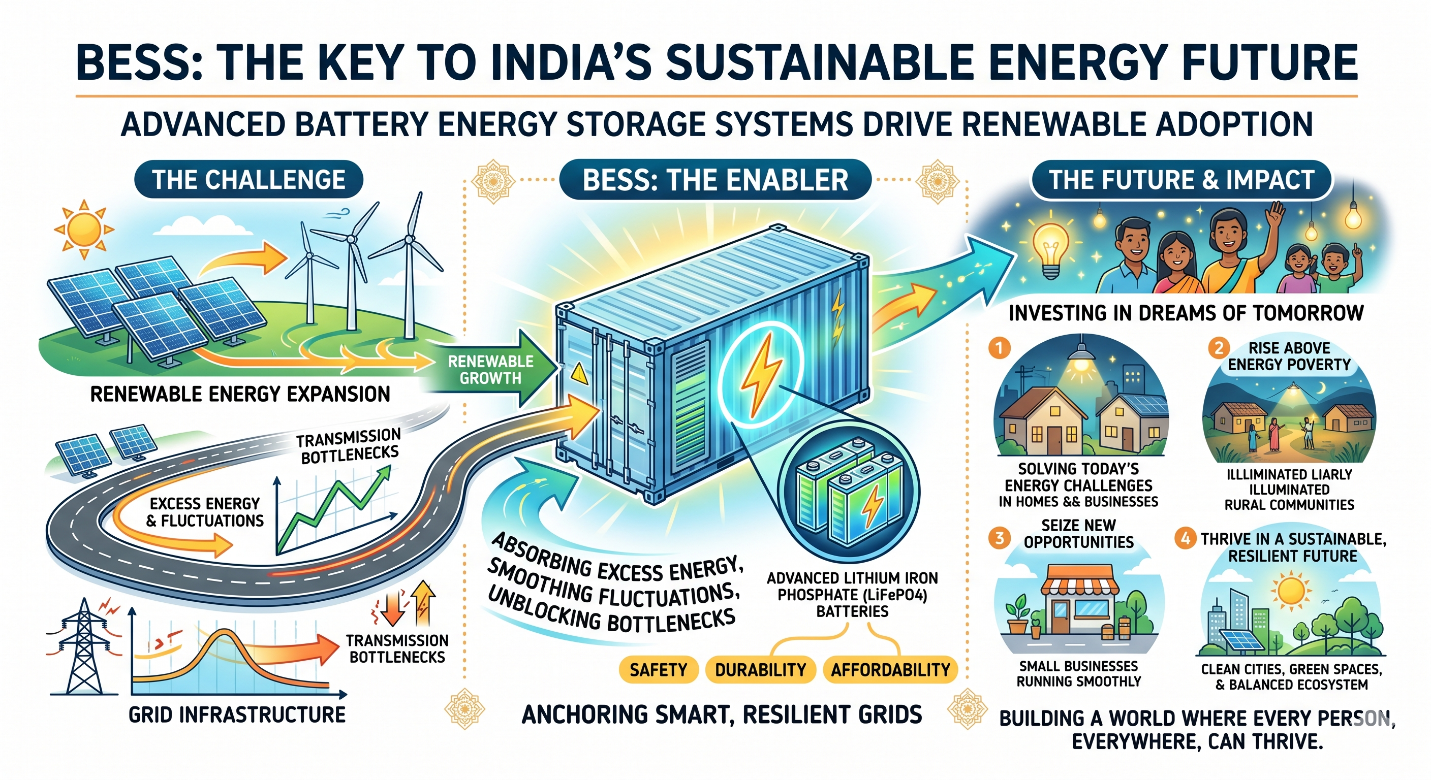
India is targeting 500 GW of non-fossil power capacity by 2030, and renewable deployment is moving fast — often faster than the grid and transmission infrastructure that has to carry it. That mismatch is exactly where storage earns its place.
In a market where renewable energy expansion is racing ahead of the grid, BESS acts as the enabler: absorbing excess generation, smoothing out fluctuations, and unblocking transmission bottlenecks. It allows developers and utilities to integrate far more solar and wind without compromising reliability — and it gives commercial, industrial and government users a path to cleaner, steadier and more cost-predictable power.
Why lithium iron phosphate (LFP) batteries?
Most modern grid-scale storage is built on lithium iron phosphate (LFP) chemistry — and for good reason. LFP batteries are prized for their thermal stability and safety, their long cycle life and durability, and their increasingly competitive cost. They contain no cobalt, which simplifies supply chains and improves sustainability.
For stationary storage, where assets must run reliably for years in the field, that combination of safety, longevity and affordability makes LFP the natural foundation for the smart, resilient grids of the future.
Built to last: why system design beats chemistry alone.
The promise of BESS goes beyond the cells inside it. Real asset longevity is achieved not just through chemistry upgrades, but through intelligent system design — treating batteries as modular, replaceable components within a robust, long-lived plant.
Conservative charge rates, precise thermal management, and disciplined operation all extend battery life. A hybrid architecture — pairing rapid-response lithium with longer-duration storage — delivers both flexibility and endurance. Designed this way, a storage plant can be maintained and augmented over time, rather than retired when a single generation of cells reaches its limit.
The next frontier: long-duration energy storage (LDES)
Today’s lithium batteries are excellent at delivering power over minutes to a few hours. But a fully renewable grid also needs to shift energy across many hours — and even across days of low sun or wind. That is the domain of long-duration energy storage (LDES).
At Prozeal Green Energy, we see LDES as the next frontier: a way to overcome the limits of current battery technologies and deliver genuinely reliable, round-the-clock clean power. The future of energy will not be defined by a single breakthrough, but by holistic architecture, smart controls and a relentless commitment to reliability and sustainability.
Powering the dreams of tomorrow
Picture a future where children study by electric light long after sunset, healthcare facilities never lose power, and businesses grow without fear of outages. By capturing every spark of renewable energy and delivering it exactly where and when it is needed, BESS makes that future possible.
By embracing battery storage today, we are not just solving the energy challenges of the present — we are building a world where everyone, everywhere, can rise above energy poverty and thrive in a sustainable, resilient future. The path to universal clean energy is bold, but with BESS lighting the way, it is a journey we can complete together.
Build with Prozeal
- As a leading EPC and IPP player, Prozeal Green Energy designs and delivers solar, wind-solar hybrid and BESS solutions for commercial, industrial and government clients across India and beyond.
Frequently asked questions about BESS
What is a Battery Energy Storage System (BESS)?
A BESS is a system that stores electricity in rechargeable batteries and releases it on demand. It captures surplus power — usually from solar or wind — and discharges it within milliseconds to balance supply and demand, stabilise the grid and provide clean power around the clock.
How does BESS help with grid stability?
BESS stabilises the grid by providing fast frequency regulation, peak shaving, renewable firming, and backup power. Because it can respond in milliseconds, it smooths the variability of solar and wind and keeps grid frequency steady — something conventional plants cannot do as quickly.
What is the difference between BESS and LDES?
A conventional BESS typically discharges over minutes to a few hours and is ideal for fast response and daily shifting. Long-duration energy storage (LDES) is designed to store and release energy over many hours or even days, making it suited to bridging longer gaps in renewable generation.
Why are lithium iron phosphate (LFP) batteries used in BESS?
LFP batteries are widely used in grid-scale BESS because they offer strong thermal stability and safety, a long cycle life and competitive cost. They also contain no cobalt, which makes their supply chain simpler and more sustainable than some other lithium chemistry.
How long does a BESS last?
A well-designed BESS can operate reliably for many years, and its life can be extended through conservative charge rates, precise thermal management, and disciplined operation. Treating batteries as modular, replaceable components also lets a storage plant be augmented over time rather than fully replaced.
What role does BESS play in India’s renewable energy transition?
As India works towards 500 GW of non-fossil capacity by 2030, BESS is essential for integrating fast-growing solar and wind into a grid that is still catching up. It absorbs surplus generation, smooths fluctuations, relieves transmission bottlenecks and helps deliver reliable, round-the-clock clean power.