Key takeaways
- The Carbon Credit Trading Scheme (CCTS) is India’s national framework for pricing and trading greenhouse gas emissions.
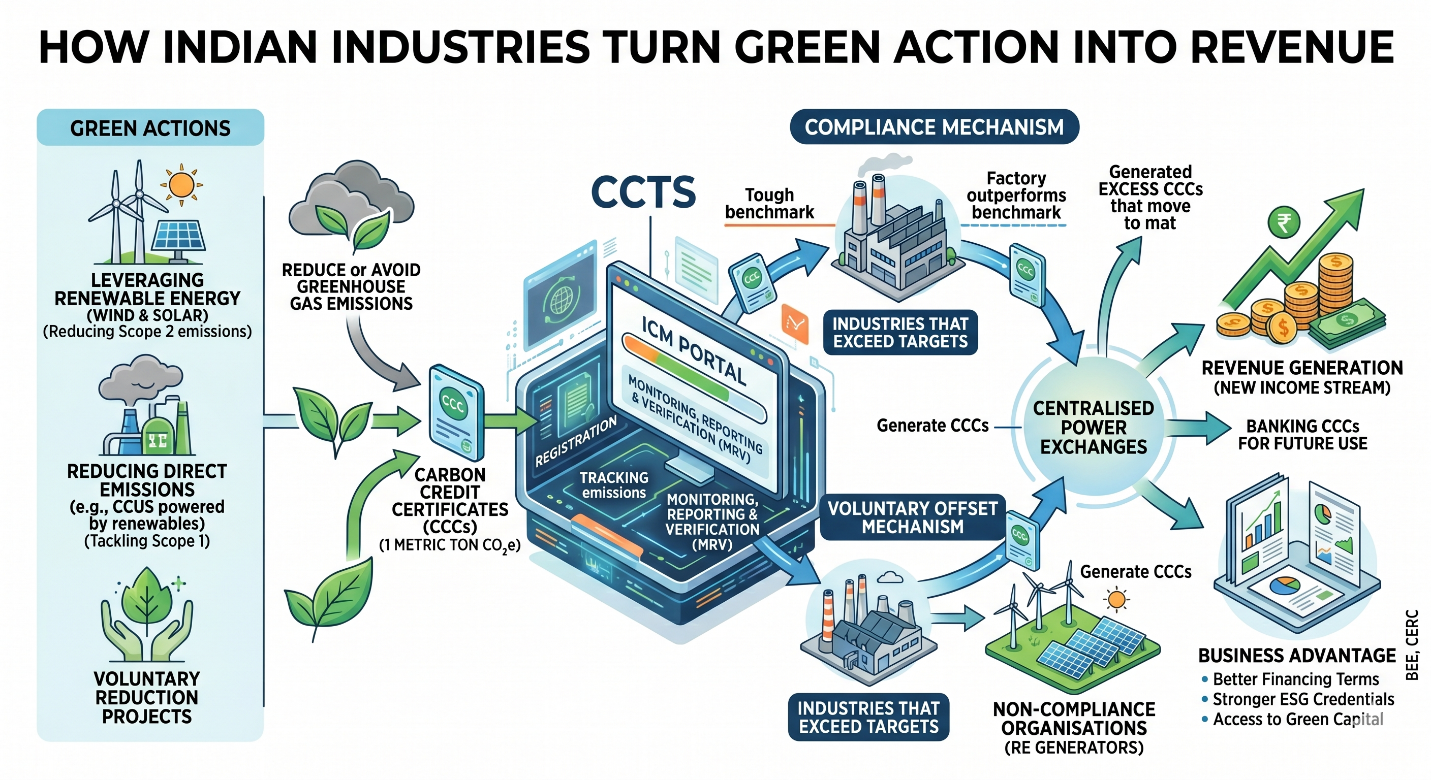
- It works through two mechanisms: a compliance market for energy-intensive industry and a voluntary offset market open to clean energy and other projects.
- Organizations that beat their emission benchmark earn tradable Carbon Credit Certificates (CCCs); those that miss must buy them.
- Compliance obligations are now live (FY2025–26) for 490 industrial units, with the first CCC trading expected by mid-2026.
- For clean-energy developers, several approved offset methodologies — solar, renewables-plus-storage, green hydrogen and offshore wind — can turn projects into a carbon-credit revenue stream.
India has put a price on carbon. At the centre of that shift is the Carbon Credit Trading Scheme (CCTS), the framework that turns greenhouse gas emissions into a tradable cost, and emission reductions into a tradable asset. For energy-intensive industry it reshapes the economics of decarbonisation; for clean-energy developers it opens a new revenue stream.
And the timing matters. With the EU’s Carbon Border Adjustment Mechanism now charging for the carbon embedded in imports, a credible domestic carbon market has moved from aspiration to commercial necessity. The CCTS is live — but building the market was only the first step. The harder work is scaling the systems, methodologies and trust that will let it function at depth.
What is the Carbon Credit Trading Scheme (CCTS)?
The Carbon Credit Trading Scheme (CCTS) is India’s national framework for pricing and trading greenhouse gas emissions. It sets legally binding emission-intensity targets for energy-intensive industries and issues tradable Carbon Credit Certificates (CCCs) to organizations that cut emissions below their benchmark — creating a market where reducing carbon has direct financial value.
Administered by the Bureau of Energy Efficiency (BEE), the CCTS evolves India’s earlier Perform, Achieve and Trade (PAT) energy-efficiency scheme into a full carbon market, aligning industrial growth with the country’s commitment to net zero by 2070.
What is a Carbon Credit Certificate (CCC)?
A Carbon Credit Certificate (CCC) is an electronic certificate representing one ton of carbon dioxide equivalent (CO₂e) that has been reduced, removed, or avoided. Each CCC is more than a number: it is verified, registry-tracked proof of climate action that can be banked or traded. By giving every avoided tonne a market value, the CCTS turns climate ambition into a measurable, tradable asset for Indian industry.
How does the CCTS work? The two mechanisms
CCTS operates through two complementary mechanisms — one mandatory, one open to all.
1. The compliance mechanism
Large, energy-intensive industries receive GHG Emission Intensity (GEI) targets — the permitted emissions per unit of output. Beat the target and you earn CCCs you can bank or sell. Miss it and you must buy credits to close the gap, or face penalties. The effect is symmetrical: every obligated entity has a direct financial reason to improve, and the strongest performers are rewarded for it.
2. The voluntary offset mechanism
Not every emission reduction comes from a regulated factory. Through the voluntary offset mechanism, organisations outside the compliance net — including renewable energy and green hydrogen developers — can register eligible projects that cut emissions and earn CCCs to sell. BEE has approved a set of methodologies spanning renewable energy, renewables paired with storage, green hydrogen, offshore wind, compressed biogas, industrial energy efficiency and nature-based removals. This opens the market to innovators of every kind and deepens its liquidity.
Who governs the CCTS?
A carbon market is only as credible as its oversight. Under the CCTS, responsibilities are split across specialized institutions:
- Bureau of Energy Efficiency (BEE) administers the scheme develops methodologies, emission trajectories and MRV protocols, and issues CCCs.
- Ministry of Environment, Forest and Climate Change (MoEFCC) — notifies the binding emission-intensity targets and aligns the scheme with India’s net-zero goal.
- National Steering Committee for the Indian Carbon Market — co-chaired by the Ministry of Power and MoEFCC, it provides apex direction.
- Central Electricity Regulatory Commission (CERC) regulates trading activity.
- Grid Controller of India — operates the national registry.
Trades take place on India’s power exchanges, keeping the market transparent and centrally cleared.
Who is covered, and when?
The CCTS is being rolled out in phases. Compliance obligations took effect from FY2025–26, covering 490 of India’s most energy-intensive industrial units across nine sectors: aluminum, cement, chlor-alkali, pulp and paper, iron and steel, fertiliser, petroleum refining, petrochemicals and textiles.
Emission-intensity targets were notified in stages through late 2025 and early 2026, using FY2024 as the baseline and setting binding targets for FY2026 and FY2027. The first trading of compliance CCCs is expected by mid-2026, with more sectors expected to join as the scheme matures.
Renewables and the carbon market: where climate goals meet business sense.
For Indian industry, clean energy is no longer just an environmental choice — under the CCTS it is a lever on the balance sheet.
Within the compliance mechanism, powering operations with captive or group-captive solar and wind cuts grid-based (Scope 2) emissions, helping an obligated entity beat its GEI target — and outperformance converts directly into bankable CCCs. Sustainability spending becomes a source of tradable value.
Within the voluntary mechanism, the opportunity is still broader. Several of BEE’s approved methodologies map onto the technologies India is scaling fastest — solar and wind, renewables paired with battery storage, green hydrogen and offshore wind. For developers, which means a well-structured clean-energy project can generate carbon credits alongside the power it produces.
Innovation for hard-to-abate sectors.
Some emissions cannot be eliminated overnight from heavy manufacturing. Here clean energy plays a second role: powering carbon capture, Utilisation and storage (CCUS) and electrifying industrial heat allow even hard-to-abate sectors to lower their footprint and strengthen their position under the scheme.
Beyond credits: ESG, green finance and the CBAM bridge
The value of CCTS extends well beyond the credits themselves.
Banking and trading
Organisations that outperform can bank credits for future compliance years or trade them to peers who need them — smoothing the whole sector’s path to its targets and rewarding early movers.
ESG and green finance
Verified, well-documented emission reductions strengthen Environmental, Social and Governance (ESG) credentials, making it easier to access green loans, sustainability-linked finance and responsible capital — an advantage that matters increasingly to lenders, investors, and public markets.
The CBAM bridge
From January 2026, the EU’s Carbon Border Adjustment Mechanism (CBAM) charges importers for the carbon embedded in goods such as steel, aluminum, cement, fertiliser, hydrogen and electricity. Crucially, a carbon price already paid in the country of origin can be set against that liability. A functioning domestic carbon market therefore does more than cut emissions at home — it helps keep Indian exports competitive in carbon-regulated markets abroad.
The digital backbone: registration, tracking and MRV.
Underpinning all of this is the Indian Carbon Market’s digital infrastructure — a centralized registry for project registration, emissions tracking and robust Monitoring, Reporting and Verification (MRV). Independent accredited verifiers check every claimed reduction before CCCs are issued, anchoring the market in data that the system, and its trading partners, can trust.
What businesses should do now?
Whether you are an obligated entity or a potential voluntary participant, the early moves are similar:
- Confirm your status. Check whether your sector and units fall under the compliance mechanism, and track BEE notifications.
- Establish your baseline. Get verified emissions and energy data in order — it is the foundation of every target and credit.
- Identify your levers. Map where captive renewables, storage, efficiency and process changes can move your emission intensity.
- Assess voluntary opportunities. If you sit outside the compliance net, a well-structured clean-energy project may qualify to generate CCCs.
- Build governance. Assign clear ownership for carbon strategy, MRV and trading.
The road ahead
For the CCTS to reach its potential, India must keep scaling local MRV capacity, strengthen market-stability mechanisms and build bridges to international frameworks. Partnerships with bodies such as the International Solar Alliance (ISA) can accelerate this — pairing the financial incentives of a domestic carbon market with global clean-energy expertise and infrastructure.
The CCTS is more than regulation. It is the financial architecture that lets economic growth and climate action move in the same direction, rewarding the industries and innovators that decarbonise fastest. India’s carbon market is here; the next leap is building the systems, methodologies and trust that turn today’s framework into tomorrow’s sustainable prosperity.
Turn the carbon market into opportunity
Prozeal Green Energy designs and delivers the solar, wind-solar hybrid, battery storage and green hydrogen projects that help businesses cut Scope 2 emissions, meet their CCTS targets and where eligible generate carbon credits.
Frequently asked questions about the CCTS
What is the Carbon Credit Trading Scheme (CCTS)?
The CCTS is India’s national carbon market framework. It sets legally binding GHG emission-intensity targets for energy-intensive industries and issues tradable Carbon Credit Certificates (CCCs) to organisations that beat their benchmark — putting a financial value on cutting emissions. The Bureau of Energy Efficiency (BEE) administers it.
What is a Carbon Credit Certificate (CCC)?
A CCC is an electronic certificate representing one tonne of CO₂-equivalent emissions reduced, removed, or avoided. It is verified and held in a national registry, and can be banked for future use or sold to other organisations.
Who manages the CCTS in India?
Several bodies share responsibility. The Bureau of Energy Efficiency (BEE) administers the scheme and issues CCCs; the Ministry of Environment, Forest and Climate Change (MoEFCC) notifies the emission targets; the Central Electricity Regulatory Commission (CERC) regulates trading; and the Grid Controller of India operates the registry. A National Steering Committee provides overall direction.
Which sectors are covered under the CCTS?
Compliance obligations are live from FY2025–26 for roughly 490 industrial units across nine energy-intensive sectors: aluminum, cement, chlor-alkali, pulp and paper, iron and steel, fertiliser, petroleum refining, petrochemicals, and textiles. More sectors are expected to be added over time.
How can renewable energy earn carbon credits in India?
There are two routes. Under the compliance mechanism, using captive or group-captive renewables cuts Scope 2 emissions and helps an obligated company beat its target, earning bankable CCCs. Under the voluntary offset mechanism, eligible standalone projects — such as solar, renewables-plus-storage, green hydrogen and offshore wind — can be registered to generate CCCs directly.
How does the CCTS relate to the EU CBAM?
From January 2026 the EU’s Carbon Border Adjustment Mechanism (CBAM) charges importers for the carbon embedded in goods like steel, aluminum, and cement. A carbon price already paid at home can be offset against that liability, so a working domestic carbon market helps keep Indian exports competitive in carbon-regulated markets.