Key takeaways
- India’s target of 500 GW of non-fossil capacity by 2030 is creating clean-energy jobs at record pace — but a widening green skills gap threatens to slow it down.
- The renewable energy sector could employ around one million people by 2030: the Skill Council for Green Jobs projects a shortfall of 1.2 million skilled workers by then.
- Frontier technologies — AI-enabled maintenance, smart grids, green hydrogen, and storage — are evolving faster than training systems can keep up.
- The hardest gaps are in specialised technical roles, senior leadership, and remote project sites.
- Government programmes (Surya Mitra, SCGJ), corporate academies, local hiring, and greater gender inclusion are the levers that will close the gap.
India’s renewable energy sector is racing ahead, setting a pace few industries can match. As the country pursues an ambitious target of 500 GW of non-fossil capacity by 2030, the green energy ecosystem is transforming rapidly — driven by bold government policy and fast-moving technological innovation. Yet even as the sector flourishes, it faces a defining challenge: a widening green skills gap that could decide the success, or the setback, of India’s clean energy future.
What is the green skills gap?
The green skills gap is the shortfall between the number of trained professionals a clean-energy economy needs and the number available. In India, demand for solar, wind, storage and green-hydrogen talent is rising far faster than education and training systems can supply it leaving critical roles unfilled even as installed capacity climbs. Closing that gap is now considered as crucial to the energy transition as financing or technology.
The growing demand for green talent
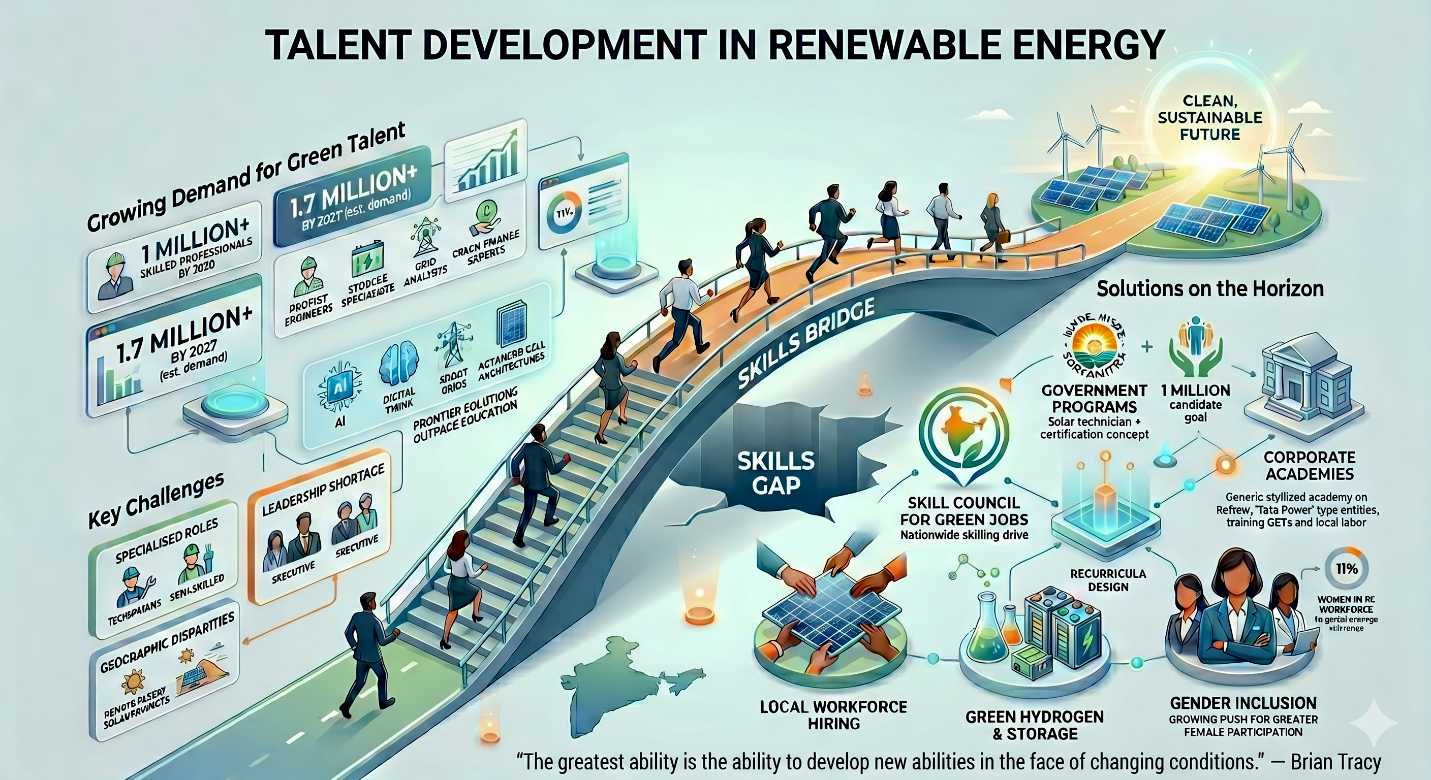
While large-scale layoffs in traditional sectors such as IT leave many skilled professionals in limbo, the renewable energy industry is creating new opportunities at a record rate. By 2030, the sector is expected to require close to one million skilled workers project engineers, system designers, storage specialists, recyclers, grid analysts, and green-finance experts among them. That is much the size of today’s clean-energy workforce.
Looking further out, the Skill Council for Green Jobs estimates that India’s wider green economy could generate 30–35 million jobs by 2047 — a generational opportunity, provided the talent pipeline can keep pace.
The technology leap — and training lag
The technologies powering this transformation — AI-enabled predictive maintenance, digital twins, advanced cell architectures, smart grids, and large-scale storage — are evolving far faster than education systems can adapt. These frontier solutions demand deeper, more specialised technical understanding, yet the number of professionals trained in these emerging areas remains limited. The result is a structural lag: capacity is being built faster than the workforce to run it.
Key challenges in the green workforce
The skills gap is not uniform it concentrates in three areas:
- Specialised technical roles. Soaring demand for site engineers and semi-skilled technicians in construction, grid integration, and solar manufacturing.
- Leadership shortage. Rapid capacity expansion has outpaced the supply of experienced leaders, creating an acute shortage of senior and CXO-level talent.
- Geographic disparities. Many project sites sit in remote locations — the deserts of Rajasthan, for instance — making it hard to attract talent from urban or industrial centres.
Solutions in motion
Recognizing these gaps, both government and industry are taking decisive action across several fronts:
Government programmes
The Ministry of New and Renewable Energy’s Surya Mitra programme, delivered through the National Institute of Solar Energy (NISE), offers a three-month residential certification to ITI and diploma holders, preparing them for work as solar PV technicians. Tens of thousands have already been trained nationwide.
Skill Council for Green Jobs (SCGJ)
The SCGJ is spearheading a nationwide skilling drive, with a goal of training around one million candidates across clean energy and emerging green technologies by 2030, supported by centres of excellence and blended online learning.
Corporate academies
Developers such as ReNew and Tata Power are building in-house academies to cultivate Graduate Engineer Trainees (GETs) and upskill local labour near project sites — turning live projects into training grounds.
Local workforce hiring
Companies are increasingly recruiting and training local populations, sidestepping relocation challenges, building community goodwill and ensuring smoother long-term operations.
Green hydrogen and storage
Emerging sub-sectors such as green hydrogen and energy storage are forcing a ground-up redesign of educational curricula to address new technical and safety requirements that older programmes never anticipated.
Gender inclusion
Women make up just 11% of India’s renewable energy workforce, against a global average of around 32%. Closing that gap is both a fairness imperative and a practical one: targeted programmes — several led by major developers — are training women as solar technicians and widening the talent pool the sector can draw on.
The road ahead
Bridging India’s renewable energy skills gap will take coordinated effort from academia, industry, and government. By scaling vocational training, investing in leadership development, and making the sector more inclusive, the country can build a robust talent pipeline for the next generation of green growth.
As India moves towards a cleaner, more sustainable future, the race for talent is on. The sector’s success will depend not just on the megawatts installed, but on the people who power the transformation.
Build your career — and your workforce — with Prozeal.
As one of India’s largest solar EPC companies, Prozeal Green Energy delivers projects across solar, wind-solar hybrid, battery storage, and green hydrogen — and invests in the skilled teams that make them happen.
Frequently asked questions
What is the green skills gap in India?
The green skills gap is the shortfall between the trained professionals India’s clean-energy sector needs and those available. Demand for solar, wind, storage and green-hydrogen talent is growing faster than training systems can supply it, leaving key roles unfilled even as renewable capacity expands.
How many green jobs will India create by 2030?
India’s renewable energy sector is expected to employ around one million people by 2030, many times today’s clean-energy workforce. Looking further ahead, the Skill Council for Green Jobs estimates the wider green economy could generate 30–35 million jobs by 2047.
What jobs are in demand in renewable energy?
Demand is strongest for project and site engineers, system designers, semi-skilled technicians in construction and solar manufacturing, grid integration and O&M specialists, energy-storage experts, recyclers, grid analysts, and green-finance professionals — plus experienced senior leaders.
What is the Surya Mitra programme?
Surya Mitra is a skill-development programme run by the Ministry of New and Renewable Energy through the National Institute of Solar Energy (NISE). It provides a three-month residential certification for ITI and diploma holders, training them as solar PV technicians for India’s growing solar sector.
What is the Skill Council for Green Jobs (SCGJ)?
The SCGJ is a government-backed body set up to address skilled-manpower needs for green and climate-resilient technologies. It runs a nationwide skilling drive aiming to train one million candidates in clean energy and emerging technologies by 2030.
Why are so few women in India’s renewable energy workforce?
Women make up about 11% of India’s renewable energy workforce, against a global average near 32%. Participation is lowest in roles needing frequent travel or on-site presence. Targeted training and inclusion programmes — several led by major developers — are working to raise that share.