
Key takeaways
- For three decades, every major energy shock has exposed the same structural weakness: India’s reliance on imported fossil fuels.
- Fossil fuels still supply around 75% of India’s primary energy — and the country imports 85–90% of its crude oil and 45–50% of its gas.
- Renewable energy is now an economic-security strategy, not just an environmental one: domestic solar and wind insulate the economy from price shocks and supply disruption.
- For businesses, captive solar, hybrids and storage reduce exposure to volatile tariffs and keep operations running through outages.
- Clean energy also builds domestic jobs and capability, supporting India’s goal of energy self-reliance by 2047.
For more than thirty years, every major energy disruption — the 2003 Gulf War, the 2008 oil-price spike, and more recent turmoil in the Middle East affecting around a fifth of global energy supply — has exposed the same structural feature of India’s economy: a deep reliance on imported fossil fuels that leaves the country exposed to forces beyond its control. When global supply tightens, the shock travels straight through India’s economy — widening the trade deficit, pushing up inflation, and forcing costly fiscal responses.
At its core, the problem is simple to state: India’s energy system runs on fuels it does not produce. And this dependence is not occasional — it is built into the system.
How does renewable energy improve economic security?
Renewable energy improves economic security by replacing imported fossil fuels with domestically generated power. Because the sun and wind are local and free of fuel cost, solar and wind shield households, businesses and governments from global price shocks, currency swings, and supply disruptions — stabilizing energy costs, strengthening the trade balance and building long-term economic resilience.
The scale of India’s import dependence
The numbers tell the story. Fossil fuels still account for 75% of India’s primary energy, and imports dominate that mix: the country buys in around 85–90% of its crude oil, some 45–50% of its natural gas, and a meaningful share of its coal — particularly higher grades. Far from easing, this reliance has deepened in recent years, with crude-import dependence climbing as ageing domestic fields produce less and demand keeps rising.
That is what makes energy security an economic question, not just an environmental one. It is also why India has set a national goal of energy self-reliance by 2047 — and why renewables are central to reaching it.
“Energy is essential for development, and sustainable energy is essential for sustainable development.” — Tim Wirth
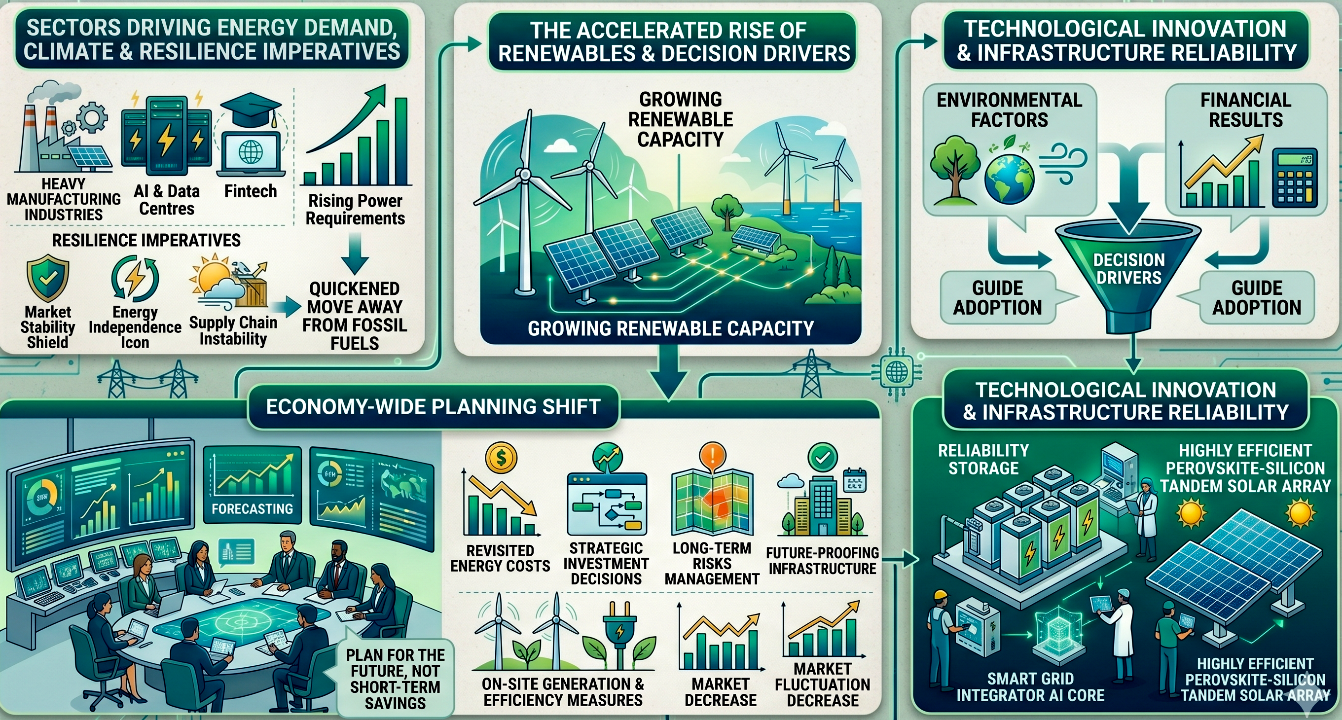
Every additional point of GDP growth now must be reconciled with the climate challenge. The sectors driving that growth — heavy manufacturing, artificial intelligence, data centres, fintech and edtech — are all intensely power-hungry. Meeting their demand cleanly and affordably is no longer optional; it is the foundation of competitive economic activity.
From environmental choice to financial decision
Renewable energy now shapes decisions across households, companies, and public bodies alike. Climate pressure, price volatility, and unstable supply chains have all accelerated the move away from fossil fuels — but increasingly it is the financial logic, as much as the environmental one, that drives adoption. As clean capacity scales and costs fall, renewables are changing how the whole economy thinks about energy costs, investment, and long-term planning.
On-site generation: managing cost and risk.
For organisations, renewable energy has become a core tool for controlling cost and managing risk. On-site and captive generation, paired with efficiency measures, gives businesses a degree of control over their energy bills that grid power alone cannot — reducing exposure to volatile tariffs and fuel-linked price swings. The benefit is strategic, not merely a line-item saving: it makes future costs more predictable, and that predictability itself is valuable.
Energy storage: keeping the lights on
Reliability is the other half of the equation. Energy storage provides power during outages and supply shortfalls, keeping operations running and minimizing costly interruptions. As uptime becomes a competitive priority — especially for manufacturing, data centres, and round-the-clock services — storage is moving from a nice-to-have to a central consideration in energy and infrastructure planning.
Together, on-site generation and storage do more than cut bills. By shifting to domestic sources such as solar and wind, regions and businesses can sidestep global disruptions, lower long-run costs and stabilise energy prices over time — the essence of energy security at a practical level.
Building domestic jobs and capability
The economic benefits extend well beyond the meter. As generation, storage and grid infrastructure expand, they create durable employment in manufacturing, installation, maintenance, and project development. Crucially, these are not one-off construction jobs: the number and stability of roles reflect the long-term scale of the sector, not just the build-out phase.
That growing demand for skilled workers feeds back into education and training, shaping economic participation and mobility as clean energy spreads. Countries that build out domestic renewable grids — India among them, as its non-fossil capacity climbs — see electricity shortfalls fall and manage peak demand more comfortably. As the United Nations has noted, this kind of local energy independence underpins economic stability and shields people from imported price increases and supply shocks.
Technology: bending the cost curve
Continuous innovation keeps reshaping economics. Advances in efficiency, generation and storage steadily lower costs and improve output, and as those gains compound, they influence where investment flows and how energy is planned over the long term. Each improvement makes renewable energy a more natural fit within mainstream economic and investment strategy — not a parallel concern, but part of the core.
Conclusion: clean energy as economic infrastructure
Renewable energy now sits at the centre of economic decision-making across society. Households are rethinking how they use and invest in energy; organisations are reshaping how they manage cost and plan; and governments are steering policy and infrastructure towards future energy goals. These shifts rest on financial stability as much as environmental ambition.
The conclusion is straightforward: renewable energy has become part of the core architecture of economic planning — shaping the balance of cost, risk and opportunity, and giving India a path to growth that is both cleaner and more secure.
Make your energy a source of security.
Prozeal Green Energy helps commercial, industrial and government clients to find right energy solution through captive and group-captive solar, wind-solar hybrids with battery storage cutting exposure to volatile tariffs and keeping operations resilient and sustainable.
Frequently asked questions
How does renewable energy improve economic security?
Renewable energy improves economic security by replacing imported fossil fuels with locally generated power. Because solar and wind have no fuel cost and are produced domestically, they shield households, businesses and governments from global price shocks, currency swings and supply disruptions stabilizing costs and strengthening the trade balance.
Why is India’s dependence on imported fossil fuels a problem?
Fossil fuels supply around 75% of India’s primary energy, and the country imports around 85–90% of its crude oil and 45–50% of its gas. That means global supply shocks and price spikes pass straight into India’s economy widening the trade deficit, raising inflation, and forcing costly fiscal responses.
How does renewable energy help businesses manage cost and risk?
On-site and captive solar, often paired with storage and efficiency measures, gives businesses more control over their energy bills and reduces exposure to volatile, fuel-linked tariffs. It makes future energy costs more predictable, which supports better long-term planning and investment decisions.
What role does energy storage play in economic security?
Energy storage provides backup power during outages and supply shortfalls, keeping operations running and reducing costly interruptions. As reliability becomes a competitive priority especially for manufacturing, data centres and round-the-clock services storage is increasingly central to energy and infrastructure planning.
Does renewable energy create jobs?
Yes. The growth of generation, storage and grid infrastructure creates durable jobs in manufacturing, installation, maintenance, and project development. Because these reflect the long-term scale of the sector rather than just the construction phase, they support lasting economic participation and skills development.
What is India’s energy self-reliance 2047 goal?
India aims to achieve energy self-reliance by 2047, the centenary of its independence, by expanding domestic production, scaling renewables, and improving efficiency. Solar, wind, and storage are central to this goal, reducing the country’s reliance on imported fuels and the economic risks that come with it.