
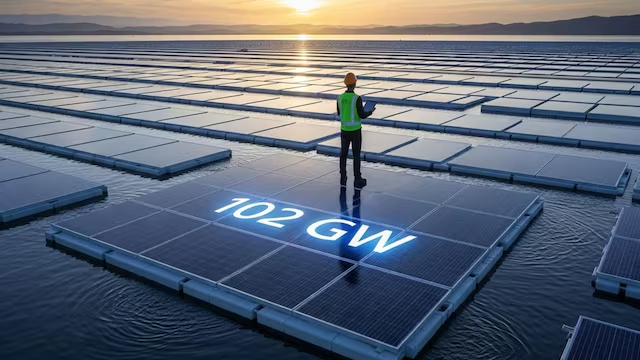
India's floating solar ambitions received a fresh push last week after National Institute of Solar Energy (NISE), in collaboration with the Ministry of New and Renewable Energy (MNRE), pegged the country's floating solar potential at 102 GW.
Floating solar involves installing solar panels on floating structures situated on water bodies such as lakes, reservoirs, and ponds. It is different from mounted ones as they are installed on land.
Floating solar use floating platforms, anchoring and mooring systems, while ground-mounted plants rely on fixed steel structures. Floating solar projects can deliver 5–10% higher annual energy yields in warm climates, while ground-mounted solar projects provide stable yields that can be improved through optimised panel tilt.
The recent development comes amid indications that the Centre is preparing a dedicated policy framework for the sector, with Union Minister Pralhad Joshi recently stating that a new scheme for floating solar projects could be launched soon.
The proposed scheme marks a significant step for a sector which offers vast promise and under utilised so far. India currently has only around 700 MW of operational floating solar PV capacity, even as estimates from the World Bank place the country's technical potential between 280 GW and 300 GW.
This could bring several listed renewable energy companies into focus, particularly developers, EPC contractors and solar equipment manufacturers.
Who stands to benefit the most?
Industry experts believe the benefits of a dedicated floating solar scheme will extend well beyond project developers, creating winners across the renewable energy value chain.
The clearest beneficiaries of India's proposed floating solar scheme are reservoir-owning public-sector utilities such as NHPC, SJVN, and NTPC/NTPC Green Energy, which already control hydro assets, have established project pipelines, and operate under a strong government mandate to scale renewable capacity.
Among private developers, as per Narender Singh, Founder at Growth Investing, Tata Power stands out due to its proven execution in floating solar, including the 126 MW Omkareshwar project.
He added that on the EPC side, Bharat Heavy Electricals Ltd is well placed, having already taken up large floating solar projects such as the 300 MW project in Odisha, alongside other key contractors like Sterling and Wilson Renewable Energy and Larsen & Toubro, which are expected to benefit from a rising pipeline of engineering and construction orders.
Solar equipment suppliers such as Waaree Energies are also likely to gain from higher module demand. Overall, NHPC, SJVN, NTPC/NTPC Green Energy, Tata Power, and BHEL emerge as the most direct listed beneficiaries of the floating solar scheme.
Key stocks set to benefit:
CategoryCompaniesReservoir-owning PSU utilitiesNHPC, SJVN, NTPC, NTPC Green EnergyPrivate developersTata PowerEPC contractorsBharat Heavy Electricals Ltd, Sterling and Wilson Renewable Energy, Larsen & ToubroSolar equipment suppliersWaaree Energies
The scheme could also spur the growth of a domestic manufacturing and engineering ecosystem. Websol's Agarwal said, "The implementation of ALMM List-II is expected to benefit domestic cell manufacturers that have invested in capacity expansion and quality standards."
The Approved List of Models and Manufacturers (ALMM) is a list of models and manufacturers of solar photovoltaic (PV) modules approved by the Ministry of New and Renewable Energy (MNRE).
Experts added that the domestic manufacturing ecosystem for the following key components would also benefit: HDPE Floats, Anchoring & mooring systems, Marine-grade cables, Specialized electrical equipment, Corrosion-resistant structures, Solar modules, Inverters, and DC and AC electrical equipment.
CNBC-TV18 takes a deep dive into India's floating solar ecosystem, examining the key policy gaps that a dedicated scheme must address, the stakeholders likely to benefit, ways to streamline approvals and project execution, and ultimately, whether floating solar is essential for India to achieve its clean energy ambitions.
Do India even need floating solar?
As Siddharth Bhatia, Managing Director & CEO, Oyster Renewable and AB Energia said, floating solar is not a replacement for ground-mounted solar — it is a strategic complement to it.
India's renewable energy ambitions are massive, as it targets to achieve 500 GW of installed non-fossil fuel electricity capacity by 2030, with solar contributing 280 GW of it.
In this scenario land availability is increasingly becoming a constraint, especially near industrial and urban demand centres. Floating solar provides an opportunity to unlock underutilised water surfaces while simultaneously reducing pressure on land acquisition.
The report underscores multiple advantages of floating solar, strengthening the case for its wider adoption in India's clean energy transition:
- Higher gains in energy production: improvement of as much as 10%, compared with land-based PV systems
- Land neutral
- Less soiling loss
- FSPV as a new source of revenue
- Complementary operation with hydroelectric power plants
- Reduction in algae growth
- Reduction in water evaporation
What policy gaps must the new scheme address?
Experts CNBC-TV18 spoke to broadly agree that the proposed floating solar scheme must address three key bottlenecks that continue to hinder large-scale deployment.
Single-window approval mechanism: Experts said that floating solar projects require coordination between multiple authorities including water resource departments, state nodal agencies, local administrations and environmental bodies. This significantly increases project timelines and uncertainty.
Shobit Rai, Co-Founder and Managing Director, Prozeal Green Energy, said, "Reservoir usage rights, water-body leasing and environmental clearances vary state to state and are negotiated case by case. Uniform, time-bound guidelines would cut the single biggest source of project delay."
Economic viability: Experts said that floating solar still runs roughly 25% more expensive upfront than ground-mounted, mainly due to floats, anchoring and mooring. Viability gap funding or targeted incentives would bridge that differential until scale brings costs down.
Oyster Renewable and AB Energia's Bhatia said, "Floating solar need financial viability support for early-stage projects since floating solar still involves higher engineering and infrastructure costs compared to conventional ground-mounted solar."
Dedicated technical standards: Sohan Lal Agarwal, Managing Director, Websol Energy System Limited, said that India needs to develop comprehensive standards covering float materials and durability, anchoring and mooring systems.
He separately added that equally important is the standardisation of long-term, bankable water-body lease frameworks across states.
"A developer cannot finance a 25-year asset on a short-term lease. The scheme can address this challenge in much the same way that the Solar Park Scheme addressed land availability by creating consistency and investor confidence," said Agarwal.
How can approvals be fast-tracked?
Experts said that the core problem is that floating solar sits at the intersection of three jurisdictions - land, water and power, so approvals today are fragmented and sequential. A developer chases water rights from one agency, environmental clearance from another, and grid connectivity from a third, each on its own timeline. This needed to be addressed.
Suggesting solutions, experts said to build on models that have already proven successful. Agarwal said that the Solar Park Scheme succeeded because it put land, approvals and infrastructure in place before inviting developers.
Policymakers can replicate a similar approach for floating solar by pre-identifying suitable water bodies, completing environmental assessments, securing inter-ministerial clearances, and offering ready-to-develop sites. "Developers can then focus primarily on execution," he added.
Prozeal's Rai backed the same, saying the Solar Park Scheme let state agencies pre-aggregate land, clearances and evacuation infrastructure before bidding, and that de-risking is what drove the utility-scale boom. "Do exactly that for water."
In addition, MNRE, working with the National Dam Safety Authority and the Central Water Commission, can develop standardised technical guidelines for floating installations covering mooring, anchoring, coverage ratios and environmental safeguards, said experts.
They believed that pre-approved standards would reduce duplication and eliminate the need for each project to establish its technical framework from scratch.
Global Outlook
Distribution of major FSPV projects by region, as per the NISE report:
Tags: clean energy, Pralhad Joshi, Solar energy, Solar Power
Byline: Navneet Singh. Everything above is transcribed directly from your screenshots — no facts added from elsewhere. Note the domestic-manufacturing infographic (Image 5) was marked "AI Generated" in the article itself; I listed those eight component categories as text since that's what the graphic conveyed, not as a quoted claim.